
Song-Kul weather is cold at night even in July, and how cold depends on the week you pick. In ten years of NASA climate data adjusted to the lake's altitude, the typical night low climbs from +1.1 °C in the first week of June to +6.4 °C at the turn of July and August, then drops below zero by the fourth week of September. The warmest window, with the fewest frosty nights, runs from about 29 June to 16 August.
Most Song-Kul pages stop at "bring warm clothes". Below is the week-by-week version: night lows, cold nights, day highs, frost, rain and snow for every week from 1 June to 30 September, plus a month-by-month view from May to October.
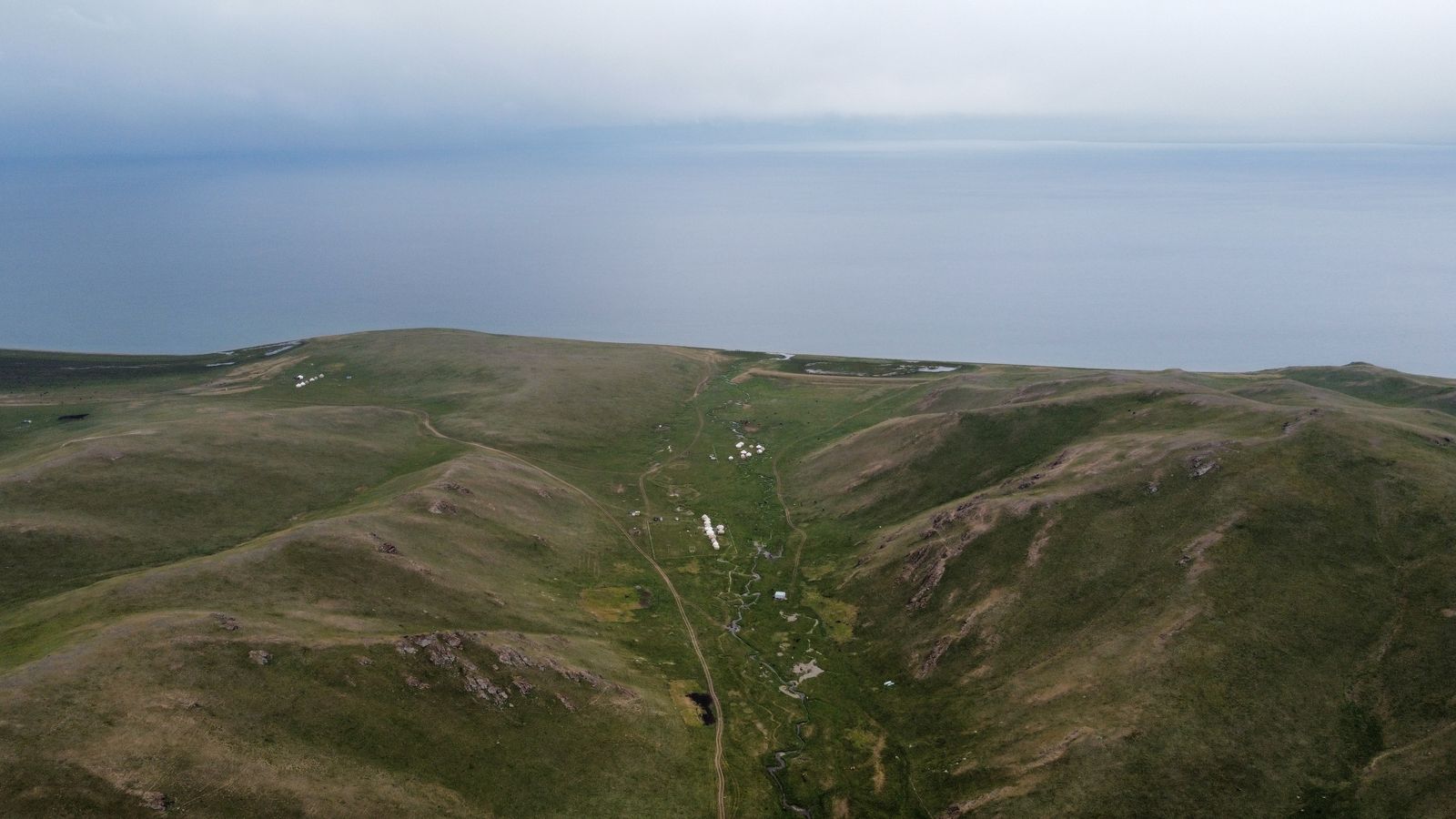 Song-Kul lake from a drone, with a yurt camp in a side valley
Song-Kul weather at a glance
What ten years of data show:
- Late June to mid-August is the safe bet. Typical night lows of +4.0 °C to +6.4 °C, and frost on 0–6% of nights. Outside that window, frost becomes a regular event rather than a rare one.
- Early June and September are cold at night. In 1–7 June about one night in four freezes (27%). By 14–20 September it's almost half (46%), and in 21–27 September most nights do (60%).
- The first week of August has been the driest. Rain fell on about 3% of days in 3–9 August over these ten years. That's a pattern, not a forecast.
- Snow can fall at both ends of the season. A few percent of days in early June, and again from mid-September.
- October is winter at lake level. Every October night in the data was at or below freezing, and yurt camps are generally closed by then. Our Song-Kul guide covers when camps open and close.
Daytime is the easy part. Typical day highs run from +13.0 °C in early June to +21.3 °C in the warmest week, 20–26 July.
Week by week, 1 June to 30 September
This is the full table. Each row covers all days in that week across 2016–2025. Here is how to read the columns:
- Typical night low is the median minimum temperature. Half the nights that week were colder, half warmer.
- Cold night is the value that 1 night in 10 was colder than. Plan your sleeping gear around this column, not the median.
- Nights at or below 0 °C is the share of nights with frost.
- Days with rain counts days with at least 1 mm of precipitation. Days with snowfall counts days with at least 0.5 mm of snow (as water).
| Week | Typical night low (median) | Cold night (1 in 10 is colder) | Typical day high (median) | Nights at or below 0 °C | Days with rain (≥1 mm) | Days with snowfall |
|---|---|---|---|---|---|---|
| 1–7 Jun | +1.1 °C | −0.7 °C | +13.0 °C | 27% | 33% | 4% |
| 8–14 Jun | +2.4 °C | −1.7 °C | +14.6 °C | 19% | 24% | 4% |
| 15–21 Jun | +3.0 °C | 0.0 °C | +14.4 °C | 11% | 30% | 0% |
| 22–28 Jun | +3.0 °C | −0.1 °C | +15.8 °C | 11% | 27% | 0% |
| 29 Jun – 5 Jul | +4.0 °C | +1.3 °C | +17.7 °C | 6% | 21% | 0% |
| 6–12 Jul | +4.3 °C | +1.7 °C | +16.7 °C | 1% | 21% | 0% |
| 13–19 Jul | +5.0 °C | +2.6 °C | +18.3 °C | 0% | 23% | 0% |
| 20–26 Jul | +6.2 °C | +3.0 °C | +21.3 °C | 0% | 10% | 1% |
| 27 Jul – 2 Aug | +6.4 °C | +3.1 °C | +19.3 °C | 0% | 23% | 1% |
| 3–9 Aug | +5.1 °C | +3.1 °C | +19.7 °C | 0% | 3% | 0% |
| 10–16 Aug | +4.5 °C | +1.0 °C | +19.0 °C | 6% | 10% | 0% |
| 17–23 Aug | +3.6 °C | +0.4 °C | +18.1 °C | 6% | 10% | 0% |
| 24–30 Aug | +3.3 °C | 0.0 °C | +17.7 °C | 10% | 13% | 0% |
| 31 Aug – 6 Sep | +1.5 °C | −1.6 °C | +17.3 °C | 24% | 6% | 0% |
| 7–13 Sep | +0.4 °C | −2.3 °C | +14.8 °C | 37% | 9% | 3% |
| 14–20 Sep | +0.2 °C | −2.9 °C | +15.6 °C | 46% | 13% | 7% |
| 21–27 Sep | −0.9 °C | −4.1 °C | +14.1 °C | 60% | 10% | 6% |
| 28–30 Sep | −1.8 °C | −4.2 °C | +10.4 °C | 80% | 17% | 10% |
The season turns at the end of August, not in mid-September. Between 24–30 August and 31 August – 6 September the typical night low drops from +3.3 °C to +1.5 °C, and frost nights more than double, from 10% to 24%. If you're choosing between the last week of August and the first week of September, the earlier week is noticeably warmer at night.
Early June is the wettest part of the season. Rain fell on 33% of days in 1–7 June, the highest share in the table. September is the opposite: cold nights, but rain on only 6–17% of days.
The warmest nights and the warmest days don't fall in the same week. The highest typical night low is +6.4 °C in 27 July – 2 August; the highest day high is +21.3 °C in 20–26 July.
Month by month, May to October
If your dates are still loose, the monthly view is simpler. It adds May and October, which sit outside the usual yurt season.
| Month | Typical night low | Typical day high | Nights at or below 0 °C | Days with rain | Days with snowfall |
|---|---|---|---|---|---|
| May | −0.9 °C | +11.1 °C | 67% | 27% | 12% |
| June | +2.3 °C | +14.7 °C | 17% | 27% | 2% |
| July | +5.2 °C | +18.9 °C | 1% | 21% | 1% |
| August | +4.0 °C | +18.6 °C | 5% | 9% | 0% |
| September | +0.2 °C | +15.0 °C | 46% | 10% | 5% |
| October | −4.8 °C | +6.2 °C | 100% | 18% | 18% |
May at the lake still behaves like late winter: two nights in three freeze and snow falls on 12% of days. October is winter outright. For the rest of the country month by month, see our guide to the best time to visit Kyrgyzstan.
July and August look similar on night lows, but August is far drier: rain on 9% of days against 21% in July. July has slightly warmer nights and almost no frost (1%).
When do nights freeze at Song-Kul?
Frost showed up in every week from 1 June to 12 July and again from 10 August onwards. The only weeks with no frost at all in ten years run from 13 July to 9 August. In June, 11–27% of nights per week freeze; in September, 24–80%.
The "cold night" column tells you more than the median. From 29 June to 23 August, the 1-in-10 cold night stayed above zero, between +0.4 °C and +3.1 °C, though a few nights in some of those weeks still froze (6% in 29 June – 5 July, 10–16 August and 17–23 August). Before and after that window, the cold night sits at or below freezing:
- 1–28 June: −0.7 °C and −1.7 °C in the first two weeks, then 0.0 °C and −0.1 °C.
- 24–30 August: right at the line (0.0 °C).
- September: −1.6 °C in the first week, falling to −4.2 °C by 28–30 September.
So "cold at night" means two different things. In July it means a few degrees above zero, cold enough that you want a proper sleeping bag. In late September it means below freezing on most nights, and water left outside can freeze.
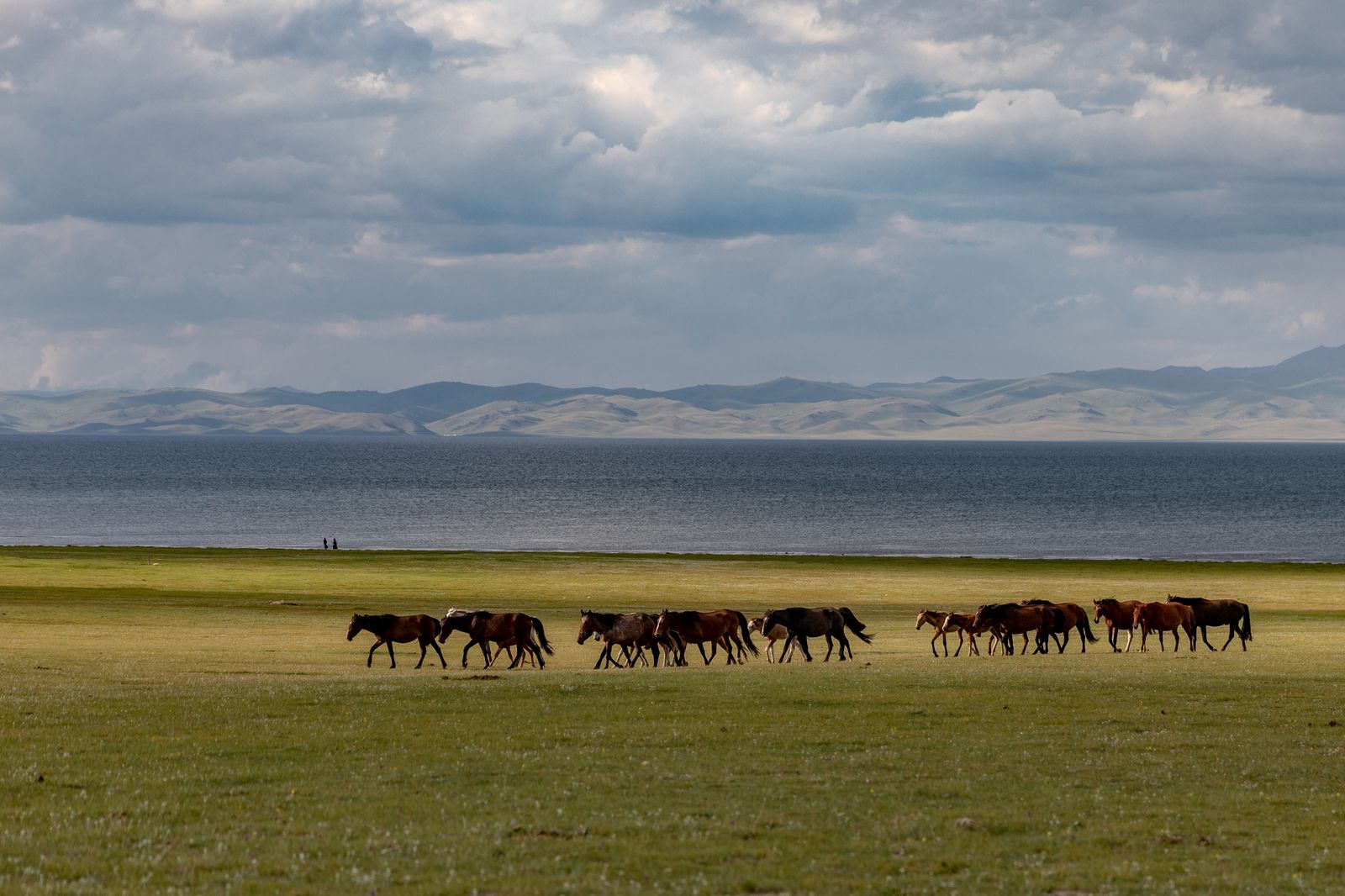 Photo: Ninara from Helsinki, Finland · CC BY 2.0Horses on the Song-Kul plateau
Rain and snow at Song-Kul
Rain is more common early in the season than late. In June, 24–33% of days per week had at least 1 mm. From 3 August the share drops to 3–17% per week and stays low through September. Treat that as a tendency, not a promise: one wet year can change it.
The data shows snowfall on 4% of days in each of the first two weeks of June, and even on 1% of days in 20–26 July and 27 July – 2 August. Most of summer is snow-free. From 7 September snow returns: 3%, then 7%, 6% and 10% in the last days of the month. A snowy morning in late September is normal at this altitude; a snowy morning in July is rare.
What this means for your trip
The table points to a simple rule. If you want warm nights and little risk of frost, go between 29 June and 16 August. If you're fine with cold nights in exchange for fewer people, June and September both work, but they fail in different ways: June is wetter, September is colder.
Who should pick July to mid-August: families with children, first-time visitors to high altitude, and anyone who sleeps cold. This is also the better window for the Song-Kul horse trek: riders spend long hours exposed on the plateau, so the lower frost risk matters.
Who can enjoy June or September: travellers with good cold-weather gear who want a quieter lake. In September, pack for freezing nights. In June, pack for both cold and rain.
What to bring, tied to the table:
| Part of the season | Typical night low | Nights at or below 0 °C | What to pack |
|---|---|---|---|
| 1–28 June | +1.1 to +3.0 °C | 11–27% | Warm sleeping bag rated below freezing, down or synthetic jacket, waterproof shell and trousers, hat, gloves |
| 29 June – 16 August | +4.0 to +6.4 °C | 0–6% | Warm sleeping bag, fleece and a warm jacket for evenings, rain shell, sun hat for day highs up to +21.3 °C |
| 17–30 August | +3.3 to +3.6 °C | 6–10% | As for July, plus a hat and gloves for the colder nights |
| 31 August – 30 September | −1.8 to +1.5 °C | 24–80% | Sleeping bag rated well below freezing, thermal base layers to sleep in, down jacket, hat, gloves, warm socks |
On any date, sleep in dry base layers and a hat, and keep tomorrow's clothes inside your sleeping bag. The cold-night column is the one to pack for.
Why the lake can feel colder than the table
The numbers are air temperatures. Song-Kul sits on an open, treeless plateau, and wind makes the same +4 °C feel much colder, especially after dark or on a horse. The data also comes from a grid cell about 50 km across, averaged over mountains, valleys and the lake itself. A camp on the shore can sit colder or warmer than that average on a given night.
How we made these numbers
We took NASA POWER daily data from the MERRA-2 reanalysis for the grid point at 41.83 N, 75.13 E, for the years 2016–2025. The grid cell's elevation is 2,825 m. The lake sits at 3,016 m, so the lake is higher than the grid cell by 3,016 m − 2,825 m = 191 m. We lowered all temperatures by 1.2 °C for that difference, using the standard lapse rate of 6.5 °C per 1,000 m.
Definitions used in the tables:
- Rain day: at least 1 mm of precipitation.
- Snow day: at least 0.5 mm of snowfall, as water equivalent.
- Frost night: a minimum temperature of 0 °C or lower.
- Typical values are medians over all days in the week (or month) across the ten years. The cold-night column is the value that 1 night in 10 was colder than.
These are modelled values from NASA's MERRA-2 reanalysis for the grid cell over Song-Kul, adjusted to lake level, not measurements at a camp. They show the pattern of the season; a given night can be colder or warmer. Nobody on our team measured them at the lake.
Data: NASA Langley Research Center (LaRC) POWER Project, funded through the NASA Earth Science/Applied Science Program. The raw data is available from the NASA POWER Project.
The Song-Kul jeep tour leaves from Bishkek and spends two nights in yurts at the lake, $475 per person in a group of four.
Song-Kul Lake 3-Day Jeep Tour
Published price, a named guide and a reply within 24 hours. From $475 per person, group of 4.
See the tripFAQ
How cold is Song-Kul at night in July?
Does it snow at Song-Kul in summer?
Is September too cold for Song-Kul?
What is the driest time to visit Song-Kul?
Sources and further reading
Last updated: September 2026. Facts are checked against the sources above; prices are the ones published on our tour pages.