
Kel-Suu (also written Kol-Suu or Köl-Suu) is a narrow, cliff-walled lake at 3,514 m in Kyrgyzstan's At-Bashy district, close to the Chinese border. To visit, you need a border-zone permit arranged in advance (allow one to two weeks), a 4x4 from Naryn (5–8 hours on rough tracks) and a 2–3 hour walk or ride from the yurt camps in the Kok-Kiya valley. The practical season is late June to mid-September.
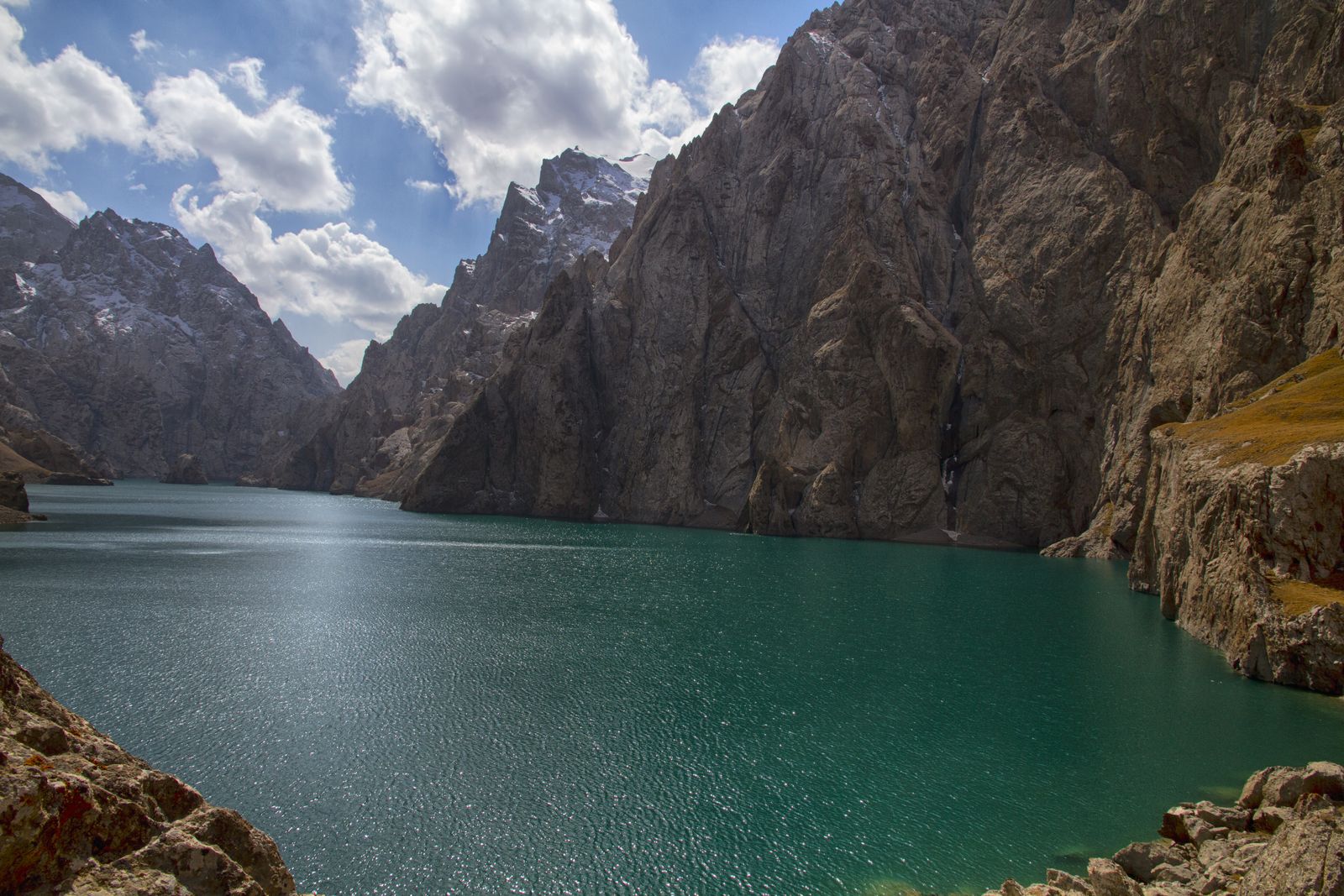 Photo: Калачев Сергей · CC BY 3.0Kel-Suu lake
Kel-Suu at a glance
| Altitude | 3,514 m |
|---|---|
| Where | At-Bashy district, Naryn region; Kakshaal-Too range of the central Tian Shan, near the Chinese border |
| Nearest town | Naryn (2,044 m). No mobile signal in the Kok-Kiya valley |
| Permit | Yes: a border-zone permit. Carry the original paper and your passport |
| From Naryn | 5–8 hours by 4x4 to the Kok-Kiya valley yurt camps |
| Last stretch | Roughly 8–13 km on foot or horseback, 2–3 hours each way, depending on your camp |
| Season | Late June to mid-September |
| Minimum time | 2 days from Naryn; 3–4 days from Bishkek |
Where Kel-Suu is, and why it looks the way it does
Kel-Suu sits in the Kakshaal-Too, the range along the border with China, in the far south of Naryn region. Wikipedia gives its length as about 5 km and its area as 4.5 km². Local guides often quote a longer length, and the size really does change with the water level. Steep rock walls rise from the water along much of the lake, and boat trips are the usual way to see more of it.
The lake is fed and drained by the Kurumduk river. The outflow starts underground: water seeps out through the rock and soil below the lake rather than over a surface outlet. Because of this, the level varies from year to year, and the lake has at times been reported almost or completely empty. Wikipedia and Central Asia Guide both mention 2019, when it drained in spring and refilled by autumn. Your view may not match the classic photos.
You will often read that Kel-Suu formed after an earthquake and landslide in the 1980s. Central Asia Guide points out that visits to the lake are documented as far back as 1879, so treat that story with caution.
The border-zone permit
This is the part that decides whether your trip happens. Kel-Suu and the road to it lie inside Kyrgyzstan's border zone along the Chinese frontier. Other permit zones include Chatyr-Kul, Inylchek and Peak Lenin. There is a military checkpoint on the way in; travellers using the Ak-Muz route in 2025 reported it near Ak-Muz.
- Who issues it: the State Border Service of Kyrgyzstan. In practice, foreigners apply through a Kyrgyz travel agency, an online permit service or the CBT (Community Based Tourism) office in Naryn. They file the application for you.
- What they need: a clear scan of each traveller's passport, your dates and the zone (for Kel-Suu, the Naryn zone). Your driver must be covered too, either on your permit or on their own.
- Lead time: agencies quoted about 5–7 working days in 2025–26, sometimes faster. Weekends and public holidays do not count. Apply at least two weeks before you plan to reach the lake, and earlier for July and August.
- Cost: recent reports range from roughly $20 to $35 per person through agencies. Multi-zone permits cost a little more and urgent processing costs extra.
- The paper: you need the original printed permit plus your passport. Copies and phone screenshots are usually refused. Permits are typically collected in Bishkek or Naryn, which is on the way.
How to get to Kel-Suu
Bishkek to Naryn
Naryn is roughly 310 km from Bishkek, about 4.5–5 hours by road, and marshrutkas and shared taxis run between the two. Trips to the lake usually start from Naryn. It is also where you can collect a permit, and where CBT Naryn and local drivers are based. Song-Kul can be combined with Kel-Suu on the same trip; see our Song-Kul guide.
Naryn to the Kok-Kiya valley
Two approaches are used. The eastern one runs from Naryn to the village of Ak-Muz, then over a pass and along the Ak-Sai valley; a 2025 traveller described that road as fairly new and in generally good condition. The western one heads south through At-Bashy towards the Torugart road, with more river crossings reported. Both end on rough tracks into the Kok-Kiya valley, where the yurt camps are. Plan on 5–8 hours one way from Naryn, depending on route, vehicle, driver and rivers. Depending on the year, expect fords, mud and rocky sections. The eastern pass is snowbound for much of the year.
There is no public transport past the last villages. A high-clearance 4x4 with a local driver is the sensible choice. One 2025 traveller saw ordinary cars at the lake, but they were slow and a heavy rain can make the final river crossing impassable. Independent travellers usually hire a car and driver in Naryn and share it: a 2026 guide estimates 3,500–5,000 som per person for the return trip with four people sharing.
The last stretch to the water
From the Kok-Kiya camps it is roughly 8–13 km to the lake, depending on the camp. That is usually 2–3 hours each way on foot, mostly gentle and steeper near the canyon. Horses can be hired at the camps. In recent seasons some vehicles have driven closer to the shore, depending on the state of the track.
Where to stay: Kok-Kiya yurt camps
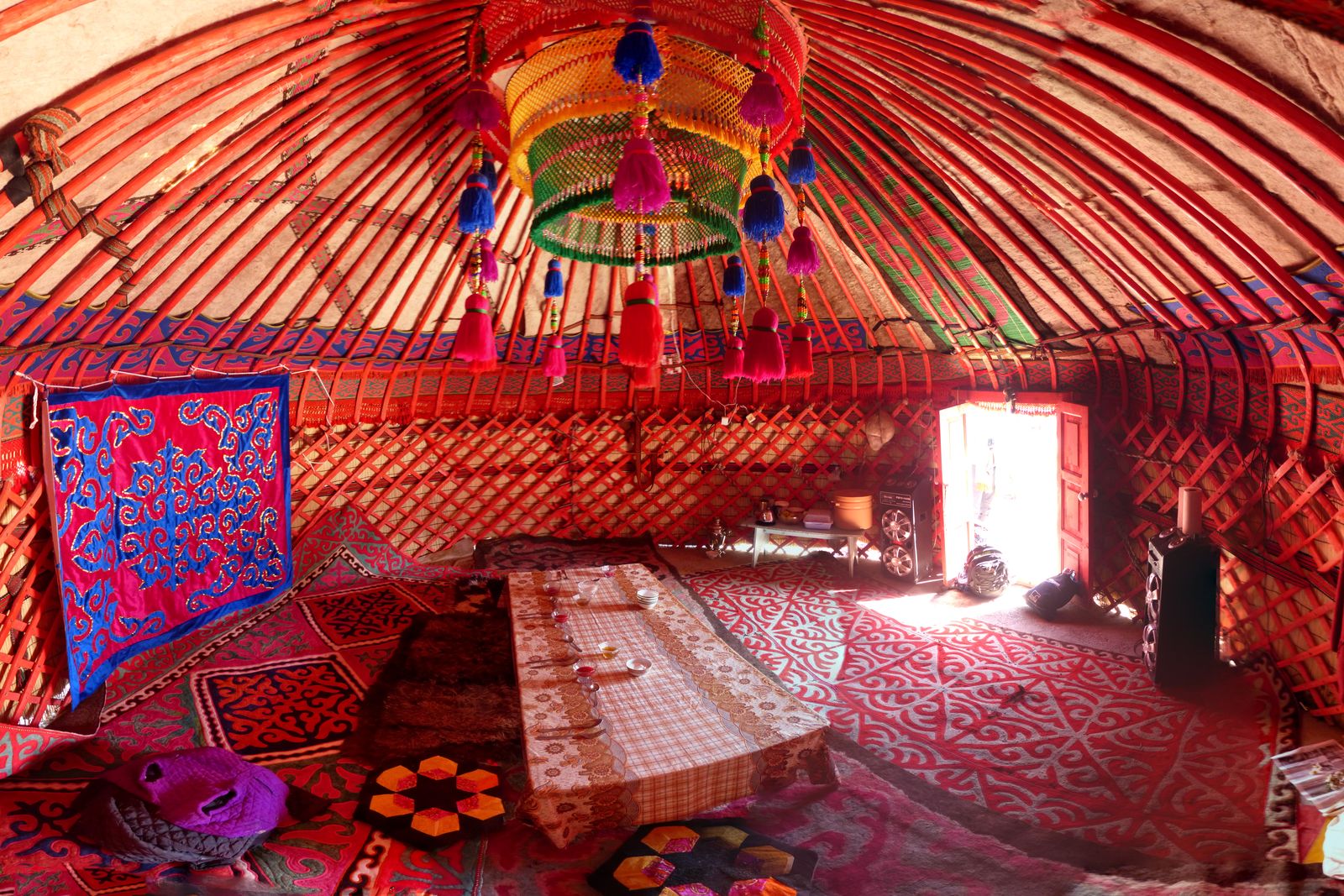 Photo: HaSe · CC BY-SA 4.0Inside a guest yurt
Several family-run yurt camps operate in the Kok-Kiya valley in summer. They typically include breakfast and dinner in the price; Journal of Nomads quoted around 1,500 som per person in 2026. You can also camp if you carry a tent. Nights at this altitude regularly fall to between 0 and −5 °C, even in summer, so bring warm layers whether you sleep in a yurt or a tent.
At the lake: boats, walking and crowds
- Boats: in summer local families run rowing boats and motorboats. Trips range from short 20–30 minute rides to several hours towards the far end of the lake. Prices are set on the spot and depend on the boat and the length of the trip.
- Crowds: Kel-Suu is no longer a quiet secret. In August 2025 one traveller on the Caravanistan forum counted 20+ people at 9:30 and around 100 an hour later, plus a couple of dozen boats, toilets and a drinks yurt. Walk in early if you want the lake to yourself for a while.
- No signal: treat the Kok-Kiya valley as offline. Download maps and tell someone your plans before you leave Naryn.
Best time to visit Kel-Suu
- Late June to mid-September: the realistic window. Camps are open and the road is passable. July and August are the surest months.
- Early and late season: some guides stretch the season from mid-June to late September. Expect colder nights, fewer camps and a higher chance of snow or high rivers.
- Outside summer: the camps close and the pass on the approach is snowbound. There is no practical way for a traveller to visit.
Kel-Suu fits well into a summer loop with Song-Kul. For the whole calendar, see the best time to visit Kyrgyzstan.
How many days you need
From Naryn, two days is the minimum. Day one is the drive to Kok-Kiya and a night in a yurt. On day two you walk to the lake and back, then drive to Naryn: a long day of 4–6 hours on foot plus 5–8 hours in the car. Three days from Naryn gives you a relaxed morning at the lake and a buffer for weather or a slow river crossing. From Bishkek, add about a day each way. Tash Rabat, a historic caravanserai in the same district, can be added if you have an extra day.
Kel-Suu with a local guide
Kel-Suu Lake 2-Day Expedition. Fixed price from $395 per person (group of 4). The start point, itinerary and what is included are on the tour page. Questions about permit timing? Ask us; we reply within 24 hours.
See the Kel-Suu Lake ExpeditionWhat to pack
- Printed original border-zone permit
- Passport (checked at the checkpoint)
- Warm jacket for nights below freezing
- Hat, gloves and warm socks
- Waterproof shell
- Sunglasses, sunhat, SPF 50
- Comfortable walking shoes with grip
- Water bottle and purification
- Snacks for the walk
- Headlamp and power bank
- Offline maps downloaded before you leave Naryn
- Cash in som for camps, boats and horses
Independent or with a tour?
You can do Kel-Suu independently. Many travellers do, usually by getting the permit through CBT Naryn or an agency and sharing a hired car from Naryn. The catch is coordination. The permit must match your dates, the driver needs to be covered, you have no signal for two days, and a missed day costs you the whole trip. A tour costs more and takes that coordination off your hands. If you have spare days and speak some Russian, the independent route is very doable.
Questions? WhatsApp or hello@asiapeaks.com. We reply within 24 hours.
Kel-Suu FAQ
Do I need a permit to visit Kel-Suu?
How long does the Kel-Suu permit take?
Can you visit Kel-Suu without a tour?
How many days do you need for Kel-Suu?
Is there phone signal at Kel-Suu?
When is the best time to visit Kel-Suu?
More planning help: our guides to Song-Kul, the Ala-Kul trek and the best time to visit Kyrgyzstan, or see all travel guides.
Sources and further reading
- Köl-Suu, Wikipedia: altitude, size, underground outflow, 2019 drainage
- At-Bashy District, Wikipedia: location, Tash Rabat
- Naryn, Wikipedia: altitude and role as the gateway town
- Kyrgyzstan border permits, Caravanistan: which areas need permits
- Kel Suu Q&A, Caravanistan forum (2025 reports on road, checkpoint, boats, crowds)
- How to visit Kel Suu lake, Journal of Nomads (2026)
- Kel-Suu practical guide 2026, KG Nomad: permit timing, transport, season
- Kel Suu lake, Central Asia Guide (2025): routes, history, drainage
Last updated: September 2026. Permit procedures and prices change, so confirm the current process with whoever files your application.