
The best nights for stargazing at Song-Kul in 2027 are 27 August to 9 September, around the new moon of 31 August. Each of those 14 nights has 4.3 to 7.8 hours of moonless astronomical darkness, and the week of 31 August to 6 September has been the clearest of the season in cloud data for 2016–2025. If you can only travel earlier in the summer, aim for 30 July to 10 August, around the new moon of 2 August.
Most Song-Kul pages tell you the night sky at 3,016 m is very dark. None of them say which nights. So we calculated it: when the Sun is far enough below the horizon for full darkness, when the Moon is down, when the bright centre of the Milky Way is above the horizon, and which weeks have been clearest. Every date and time below is for the lake itself, in local Kyrgyzstan time (UTC+6).
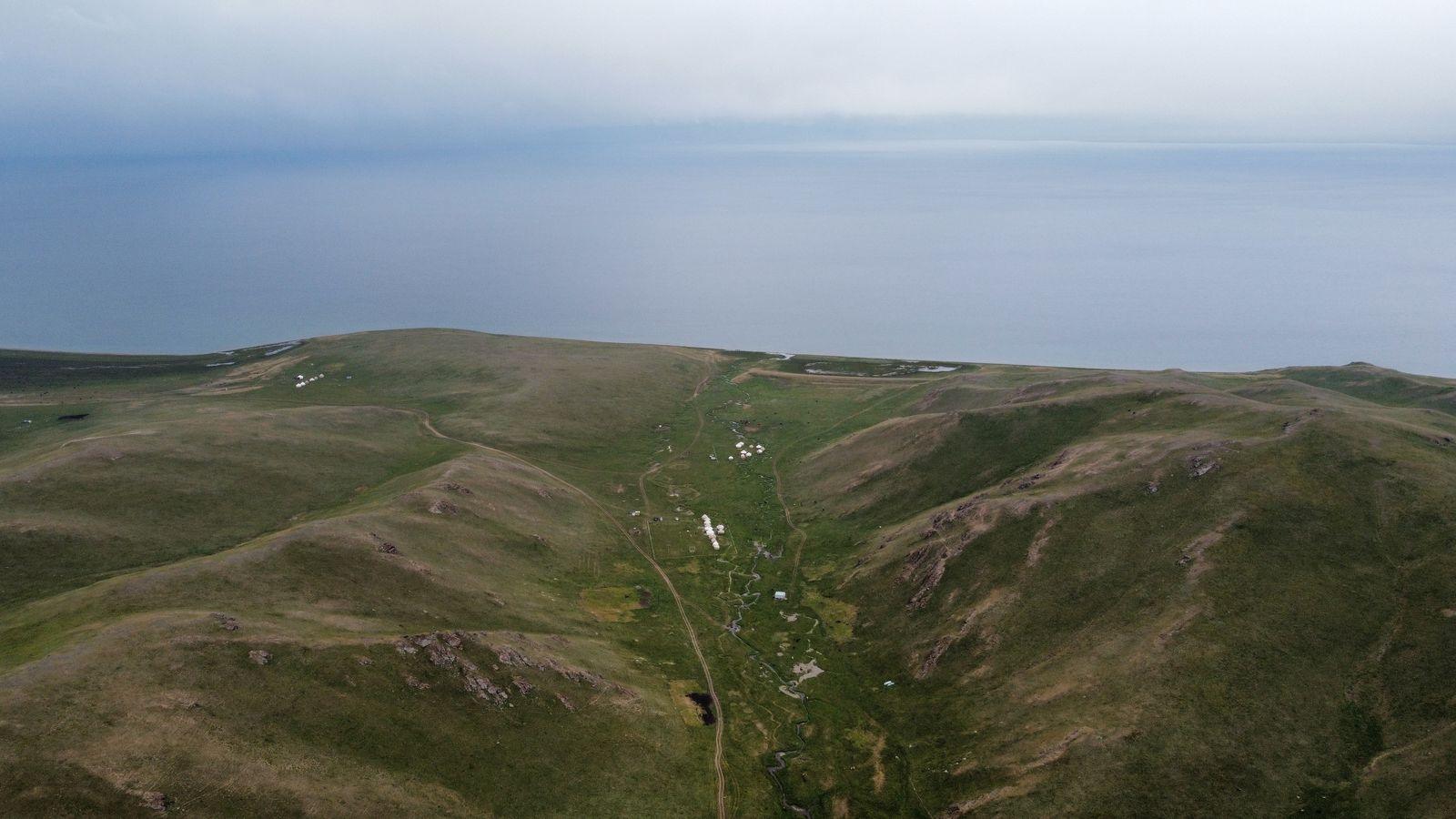 Song-Kul lake from a drone, with a yurt camp in a side valley
At a glance
| If you want… | Go on these nights (2027) | Why |
|---|---|---|
| The best overall chance | 27 Aug – 9 Sep | 4.3–7.8 h of moonless darkness, clearest week in the cloud data |
| A summer trip with dark skies | 30 Jul – 10 Aug | 4.0–6.2 h of moonless darkness, around the new moon of 2 August |
| Early-season nights | 1 Jun – 7 Jun or 1 Jul – 8 Jul | Short darkness (4.0–4.8 h and 4.3–4.7 h), cloudier weeks |
| The longest nights | 24 Sep – 30 Sep | Up to 9.2 h of moonless darkness, but the Milky Way core is already too low |
Avoid the few nights either side of each full moon if the Milky Way is what you came for. The Moon washes it out.
The best nights in 2027
The Moon decides more than anything else. A bright Moon above the horizon hides the faint stars and the Milky Way, so the useful nights cluster around each new moon. Here are the 2027 phases for the June to September season:
| Phase | Date and time (local) |
|---|---|
| New moon | 5 June 2027, 01:40 |
| Full moon | 19 June 2027, 06:44 |
| New moon | 4 July 2027, 09:01 |
| Full moon | 18 July 2027, 21:44 |
| New moon | 2 August 2027, 16:05 |
| Full moon | 17 August 2027, 13:28 |
| New moon | 31 August 2027, 23:41 |
| Full moon | 16 September 2027, 05:03 |
| New moon | 30 September 2027, 08:35 |
We then counted the nights that give you at least 4 hours of real darkness with the Moon below the horizon. Dates are evening dates: "1 Jun" means the night that starts on the evening of 1 June.
| Nights (evening dates) | Nights in window | Moonless dark hours per night | Nights with the Milky Way core up for ≥1 moonless hour |
|---|---|---|---|
| 1 Jun – 7 Jun 2027 | 7 | 4.0–4.8 h | 7 of 7 |
| 1 Jul – 8 Jul 2027 | 8 | 4.3–4.7 h | 8 of 8 |
| 30 Jul – 10 Aug 2027 | 12 | 4.0–6.2 h | 10 of 12 |
| 27 Aug – 9 Sep 2027 | 14 | 4.3–7.8 h | 10 of 14 |
| 24 Sep – 30 Sep 2027 | 7 | 4.3–9.2 h | 0 of 7 |
Late August into early September: our pick
The window from 27 August to 9 September has everything going for it at once. The nights are long, up to 7.8 hours of moonless darkness. The week of 31 August to 6 September is the clearest in the cloud data, mostly clear on 56% of days. And the Milky Way core is still above the southern horizon in the evening on 10 of the 14 nights.
The cost is cold. By the end of the season the nights at the lake are noticeably colder than in July, and you'll be standing still for hours. Check the week you're going in our Song-Kul weather by week data before you pack.
The summer window is 30 July to 10 August
If you're tied to July or early August, this is the one. It sits around the new moon of 2 August, gives 4.0 to 6.2 hours of moonless darkness, and the core is up on 10 of the 12 nights.
One trap here. In the cloud data, 20–26 July has been one of the clearer weeks of the summer. In 2027 it falls just after the full moon of 18 July, so those clear evenings will be lit by a bright Moon. Good for photos of the lake, poor for the Milky Way. For dark skies, book the yurt nights for 30 July to 10 August instead.
June and early July
Both windows work, but darkness is short and June has been the cloudiest part of the season. The upside: the core is up on every night of both windows. If June is your only option, go for 1–7 June and treat any clear night as a bonus.
Darkness by month
Astronomical darkness starts when the Sun drops more than 18° below the horizon (the standard definition). Before that, a faint glow stays in the sky even after sunset. At Song-Kul's latitude, June nights barely get there.
| Month | Astronomical darkness (1st → last night of the month) | Average dark hours per night | Nights with ≥4 h moonless darkness |
|---|---|---|---|
| June | 22:33–03:20 → 22:49–03:17 | 4.6 h | 7 |
| July | 22:48–03:18 → 22:13–03:58 | 5.1 h | 10 |
| August | 22:12–04:00 → 21:14–04:45 | 6.7 h | 15 |
| September | 21:12–04:47 → 20:16–05:22 | 8.5 h | 16 |
June has the shortest darkness of the season, under 5 hours a night, and on the first night of the month it doesn't start until 22:33. It's pleasant for a long evening outside and the weakest month for deep-sky photos.
By September, full darkness arrives at 21:12 on the first night and at 20:16 on the last, so you can be out right after dinner. Note that the "average dark hours" column ignores the Moon. The last column is the one that matters for the Milky Way.
Clear-sky weeks
The weather can't be predicted this far ahead, but the record shows which weeks tend to be clearer. We took daily cloud amount for Song-Kul from NASA POWER for 2016–2025 and grouped it by week. A "mostly clear" day is one with a daily mean cloud amount below 30%.
| Week | Median cloud amount | Mostly clear days (<30% cloud) |
|---|---|---|
| 1–7 Jun | 69% | 4% |
| 8–14 Jun | 73% | 14% |
| 15–21 Jun | 60% | 10% |
| 22–28 Jun | 54% | 11% |
| 29 Jun – 5 Jul | 50% | 34% |
| 6–12 Jul | 58% | 21% |
| 13–19 Jul | 65% | 26% |
| 20–26 Jul | 35% | 46% |
| 27 Jul – 2 Aug | 54% | 19% |
| 3–9 Aug | 40% | 29% |
| 10–16 Aug | 47% | 31% |
| 17–23 Aug | 47% | 37% |
| 24–30 Aug | 38% | 41% |
| 31 Aug – 6 Sep | 19% | 56% |
| 7–13 Sep | 38% | 41% |
| 14–20 Sep | 40% | 41% |
| 21–27 Sep | 31% | 47% |
| 28–30 Sep | 53% | 17% |
Read this with one caveat in mind. Cloud amount here is an average over the whole day and night. At Song-Kul, afternoon clouds often clear by night, so the night sky is usually better than these numbers suggest. Use the table to compare weeks, not as the odds of a clear night.
June has been the cloudiest stretch, with mostly clear days on 14% of days or fewer in every week from 1 to 28 June. From 17 August to 27 September the figure sits between 37% and 56%. The 28–30 September row covers only three days, so don't read much into it.
Put the tables side by side and the late-August window wins twice: longer moonless nights than any window before it, and the clearest week in this data.
For the wider picture of when to come, including roads and the yurt season, see our Song-Kul guide and best time to visit Kyrgyzstan.
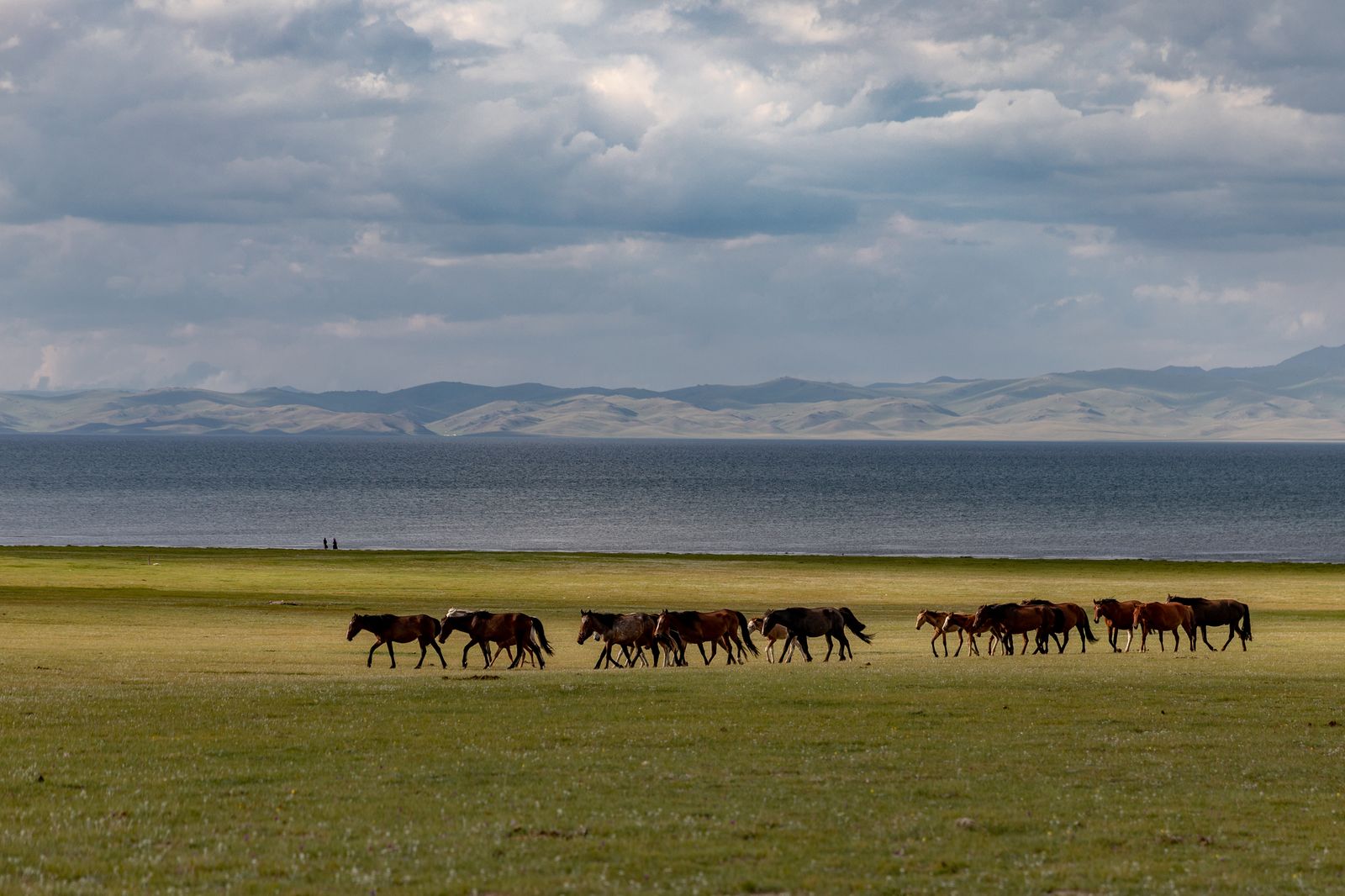 Photo: Ninara from Helsinki, Finland · CC BY 2.0Horses on the Song-Kul plateau
Where to look (the Milky Way core)
The bright centre of the Milky Way sits in the direction of the Galactic Centre, in Sagittarius. From Song-Kul it never rises higher than about 19° above the southern horizon. That's low. A ridge, a yurt or a parked jeep to your south can hide it.
That makes your spot at the camp matter more than any gear:
- Face south with an open view. If your camp is on the north shore, the lake lies to the south, and open water makes a dark, flat foreground. On the south shore the mountains rise right behind the camps and can hide a core this low, so the north shore is the better side for the Milky Way.
- Get away from lights. Walk a few minutes away from the yurts, any lit windows and car headlights. Give your eyes time to adjust before you judge the sky.
- Time it to the month. The core peaks earlier each month: after midnight in June, around midnight in early July, and in the evening by August. In late August, start looking south as soon as full darkness falls. By the 24–30 September window it is already too low by the time it's fully dark and moonless, which is why that window scores 0 of 7 for the core despite its long nights.
What to bring
Stargazing means sitting still in the cold at altitude for hours. Pack for that:
- Warm layers you can add on top of everything else. A down or synthetic jacket, hat, gloves and warm socks. Our weather by week page has the night temperatures for each week of the season.
- A headlamp with a red light. White light ruins your night vision, and everyone else's.
- A tripod. Any Milky Way photo needs a long exposure. Keep it low; the plateau is windy.
- Spare batteries, kept warm. Cold drains them fast.
- Something to sit on. The ground is cold and often wet with dew.
If one evening clouds over, the next moonless night is your second chance. That's a good reason to spend two nights at the lake rather than one.
How we worked this out
We computed the Sun, Moon and Galactic Centre positions with PyEphem 4.2 for Song-Kul at 41.83 N 75.13 E, 3,016 m. The rules:
- Astronomical darkness: the Sun more than 18° below the horizon (Sun below −18°).
- Moonless: the Moon below the horizon.
- Milky Way core up: the Galactic Centre (Sgr A*) more than 10° above the horizon.
- Best windows: runs of nights with at least 4 hours that are both astronomically dark and moonless.
For cloud we used NASA POWER daily CLOUD_AMT (daily mean cloud amount, %) for 2016–2025, grouped into weeks. A day counts as mostly clear when the daily mean is below 30%.
What this can't tell you. The astronomy is exact for a point at the lake, but a ridge on your horizon can hide the Moon or the core earlier than the calculation says. The cloud data describes past seasons, not 2027, and it averages day and night together. A clear week in the record is a better bet, not a promise.
Ilgiz lives in Kochkor, where the road up to the lake starts. The Song-Kul horse trek goes over the Kyzart route from Kochkor in 3 days with 2 yurt nights, $420 per person in a group of four. For the darkest nights of 2027, the Song-Kul jeep tour from Bishkek includes 2 yurt nights, $475 per person in a group of four. If your dates fall inside 27 August to 9 September, both yurt nights are in the best window of the year.
Song-Kul Lake 3-Day Jeep Tour
Published price, a named guide and a reply within 24 hours. From $475 per person, group of 4.
See the tripFAQ
When is the best time to see the Milky Way at Song-Kul?
How many hours of darkness are there at Song-Kul in summer?
When is the new moon in August 2027?
Is it cloudy at Song-Kul at night?
Sources and further reading
- PyEphem astronomy library (Sun, Moon and Galactic Centre positions)
- NASA POWER Project, daily cloud amount
- Astronomical twilight — Wikipedia
- Galactic Center — Wikipedia
Last updated: October 2026. Facts are checked against the sources above; prices are the ones published on our tour pages.